The Courage to Disappoint and the Hidden Cost of "Yes"
I'm becoming even more committed to the philosophy of Improve LESS.
Not because organizations have fewer problems to solve. Quite the opposite. There is no shortage of opportunities to improve. Every manufacturing plant, distribution center, or business operation has processes that could work better.
And there is no shortage of motivated people who want to make those improvements happen.
The challenge isn't finding something to improve. It's having the courage to decide what deserves our attention RIGHT NOW.
Lately, I've been seeing a lot of discussion about strategy being defined by what we say "NO" to. I agree with that sentiment. In fact, it's a concept I emphasize in my book, Improve LESS. But saying NO is easier to talk about than it is to practice. Because every NO has a person behind it.
Someone who identified a problem. Someone who developed an idea. Someone who believes their project deserves attention. And as leaders, we don't like disappointing people. So, we say "YES".
Unfortunately, those good intentions can create an improvement system that is incapable of delivering on all its commitments.
When Three More Projects Doesn't Sound Like Much
I'm preparing to facilitate a steering team discussion with a manufacturing client as they evaluate their Operational Excellence priorities for the coming quarter.
They currently have four active improvement projects. As we look ahead, there are several additional opportunities that could be pursued. Adding three more projects doesn't initially sound unreasonable. It's only three more. Right? But when we look at the total commitment, those additions would put their first-quarter improvement workload above what they committed to during all of 2026.
Let that sink in.
In one quarter, the organization could be taking on more improvement work than it committed to over the previous twelve months. Now, I'm not suggesting these additional opportunities aren't worthwhile. They may all have legitimate business cases. They may improve quality, reduce costs, increase capacity, or strengthen customer service.
And the people proposing them are probably right about their potential value. But that's not the only consideration. The question is whether the organization has the capacity to deliver those improvements while sustaining everything else already underway. That's an entirely different conversation. And it's a conversation leadership needs to own.
Every YES Has a Hidden Cost
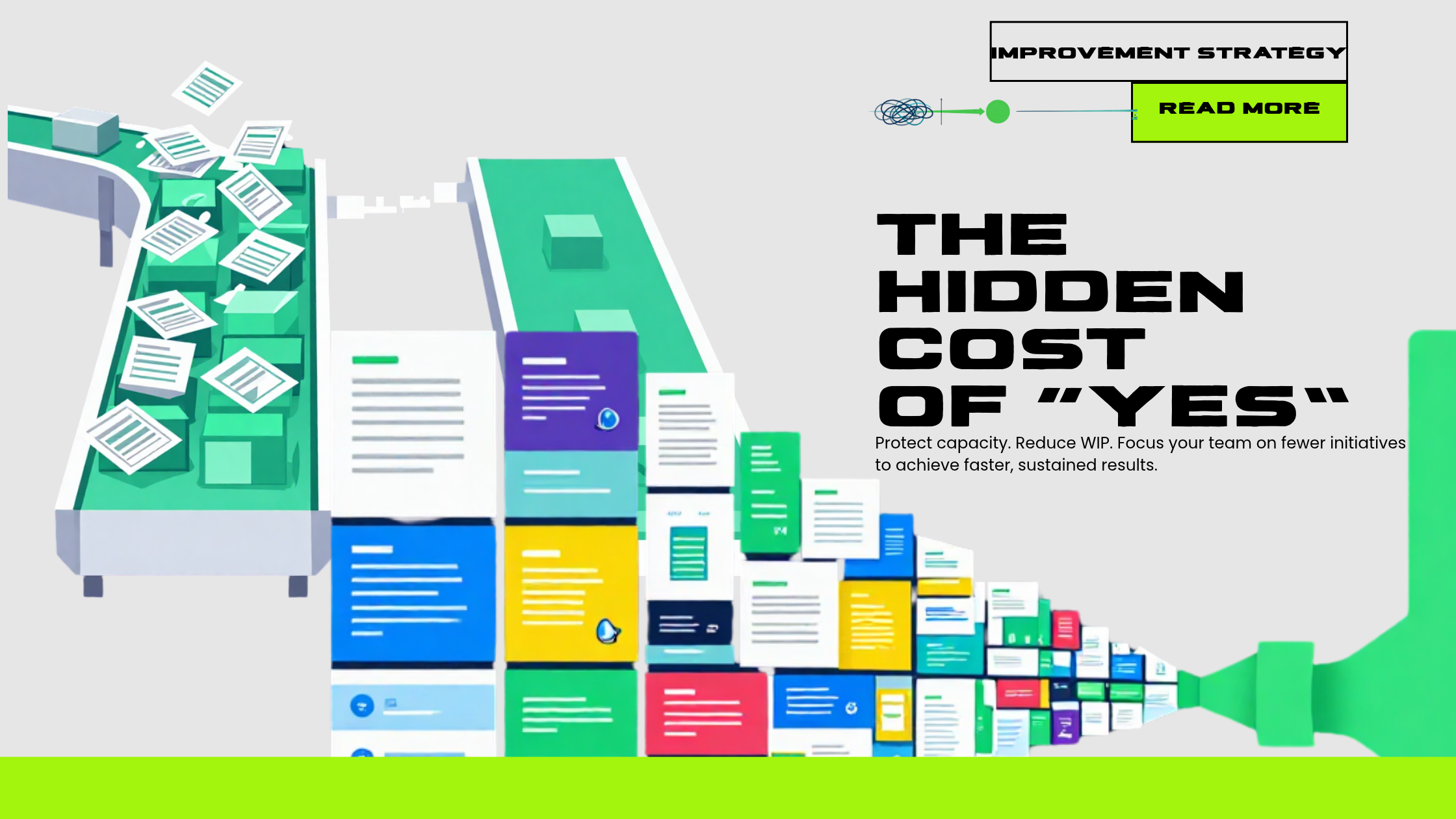
Manufacturing leaders understand the concept of Work in Process (WIP). When we release more work into a production system than the process can handle, queues grow. Lead times increase. Priorities change. Expediting becomes routine. We may have more jobs in the factory, but that doesn't mean we're shipping more product. Why do we expect our improvement projects to behave differently?
Every project requires resources.
People need time to investigate problems, gather data, test solutions, engage stakeholders, and implement changes. Managers need to make decisions, remove barriers, and verify results. And perhaps most importantly, teams need capacity to stabilize the new processes so the improvements actually stick.
When we continue adding projects without considering available capacity, we create the same problems we work so hard to eliminate in our operations.
- People split their time between competing priorities.
- Decisions wait for leadership attention.
- Project schedules slip as daily firefighting takes precedence.
- Improvements are implemented but never fully stabilized.
- Teams become busy reporting activity instead of delivering results.
Sound familiar?
We wouldn't intentionally overload a production bottleneck and expect lead time to improve. Yet we routinely overload our improvement teams and wonder why projects take so long. Every YES to a new project is also a decision to divide attention among the projects already underway. Even when we don't acknowledge that tradeoff.
The Courage to Disappoint
Here's where leadership gets uncomfortable...
Most organizations don't struggle to identify worthwhile opportunities. They struggle to choose between them.
- The quality manager has a legitimate concern about defects.
- The production manager sees an opportunity to improve throughput.
- The supply chain team wants to reduce inventory and improve delivery.
- And the finance team has identified a cost reduction opportunity.
All important.
All supported by capable people who care about the business.
So, who gets told NO?
It's tempting to approve everything and let the teams figure out how to make it happen. But that's not prioritization. That's pushing the difficult decision down into the organization.
When everything is a priority, people are left to make tradeoffs themselves. They divide their attention, compete for resources, and negotiate which commitment gets attention this week. Leadership has effectively delegated strategy to whoever is managing the busiest calendar. And the irony is that our desire to avoid disappointing someone today can lead to disappointing everyone later when commitments aren't delivered.
Sometimes the most supportive thing a leader can do is say NO to a good idea. Not because the idea lacks merit. But because something else is more important right now.
"NO" Doesn't Have to Mean Never
This is an important distinction that I think gets lost in conversations about strategy. When we say NO to an improvement opportunity, we aren't necessarily rejecting it. More often, we're saying NOT YET.
There is a difference between an opportunity and a commitment. An opportunity is something worth considering. A commitment is something we are allocating resources to accomplish. And we should be intentional about moving an opportunity from one category to the other.
I want organizations to continually identify problems. In fact, a healthy Daily Management system should make problems more visible, not less. But identifying a problem doesn't automatically mean it deserves a formal project. Some issues require immediate action to protect safety, quality, or customer delivery. Others can be resolved through routine problem-solving. And some deserve dedicated, cross-functional improvement resources because they represent significant gaps in business performance.
The job of leadership is to distinguish between them. When a worthwhile opportunity isn't our current priority, we should capture it, communicate why it is being deferred, and establish when it will be reconsidered.
That last part matters.
"Not Yet" shouldn't become a polite way of saying "Never." It should be a deliberate decision to sequence our improvement efforts. When we complete more of what we start, we create the capacity to start what comes next. That is how saying NO today can allow us to say YES sooner tomorrow.
Move Faster by Committing to LESS
I am increasingly convinced that quarterly improvement sprints are a better way to translate annual strategy into meaningful action. Our strategic objectives and annual performance goals establish the direction. But we shouldn't feel obligated to launch every initiative identified during the annual planning process.
Instead, use a quarterly cycle to focus resources on the MOST IMPORTANT THING RIGHT NOW.
A simple approach:
1. Review what is already underway.
Before adding anything new, understand the existing commitments.
What is progressing? What is stuck? Which projects need additional resources? Which improvements are complete but still require attention to sustain?
Don't treat unfinished work as if it no longer consumes capacity.
2. Prioritize the biggest opportunity.
Look at the gaps between actual performance and your strategic goals.
Which improvement, if accomplished, would create the greatest contribution to the organization over the next quarter?
Consider business impact, urgency, and the resources required.
This is where leadership makes the hard decisions.
3. Create a deliberate "Not Yet" list.
Don't lose the good ideas that aren't selected.
Capture them, communicate the prioritization decision, and commit to reconsidering them during the next planning cycle.
People are more likely to support a difficult decision when they understand the reasoning and trust that their ideas aren't simply disappearing.
4. Execute with urgency and reassess.
Use a 90-day execution cycle with clear ownership, measurable outcomes, and routine progress reviews.
At the end of the quarter, evaluate what was accomplished, what needs to be sustained, and what deserves priority next.
Some improvements will take longer than 90 days. That's okay.
The quarterly cadence is not a requirement to finish every project within the quarter. It is an opportunity to learn, realign, and manage commitments based on current business conditions.
And here is the payoff.
By limiting the number of active projects, teams spend less time switching between priorities and more time making progress. Projects move toward completion, results are realized, and resources become available for the next opportunity. Over the course of a year, we may actually complete MORE projects than we would have by launching everything at once.
Not by working harder. By working with greater focus.
It's Not About Doing Less Improvement
I want to be clear about something. Improve LESS is not an argument for complacency. It isn't about lowering expectations, avoiding difficult problems, or reducing our ambition. It's about increasing our ability to execute. When leaders establish a clear direction, align resources to the highest-priority problems, and protect teams from competing commitments, improvement can happen faster. And when those improvements are sustained through Daily Management, we don't need to keep revisiting the same problems. We create capacity for the next opportunity.
That is the difference between an organization that is always starting improvement projects and one that is consistently delivering better business performance. The goal isn't to do fewer projects forever. The goal is to finish more of the RIGHT projects, faster, and sustain the results. Sometimes that requires the courage to disappoint someone in the short term.
But I'd rather have a team disappointed that their project isn't starting this quarter than frustrated six months from now because none of our projects are getting finished.
Are Your Improvement Priorities Actually Aligned?
Here's a challenge for your next leadership or Operational Excellence review.
Look at your active improvement initiatives and ask:
- Which business goal does this directly support?
- What measurable result are we expecting?
- Do we have the capacity to execute and sustain it?
- If we could only complete ONE initiative next quarter, which would have the greatest impact?
- What opportunities should we put on our "Not Yet" list?
If those questions are difficult to answer, you may have an alignment problem before you have an execution problem.
At Bareither Group Consulting, we developed the Focus & Align Assessment to help leaders identify where their business management system may be limiting performance.
The assessment helps uncover gaps in strategy, execution, and leadership practices so you can focus your next improvement effort where it matters most.
Take the Focus & Align Assessment
Before committing to your next improvement project, make sure you're focused on the right one.
That's how you #improveLESS … and get better results.