You Don’t Need a Better Tool. You Need a Better View of the Problem.
There is no shortage of improvement ideas.
Open social media and you can find a 60-second clips of clever fixtures, a visual management boards, kanban systems, scheduling methods, or new ways to organize work. Walk through a well-run manufacturing plant and you will see dozens of practices worth noticing. Attend a conference and you can leave with pages of ideas.
That exposure is useful. It can also create a trap. We see a solution that appears to be working somewhere else and immediately ask, “How can we do that here?” A better question is usually, “What problem were they trying to solve?”That distinction matters.
The fact that another company does not have a problem you have does not mean they once had the same problem. It may mean they designed their system around a completely different set of constraints. Their product mix may be different. Their customer expectations may be different. Their equipment, staffing model, lead times, demand pattern, or growth stage may be different. We can learn from what others are doing. But copying their countermeasure without understanding our own problem is rarely a good improvement strategy.
The danger of seeing solutions before problems
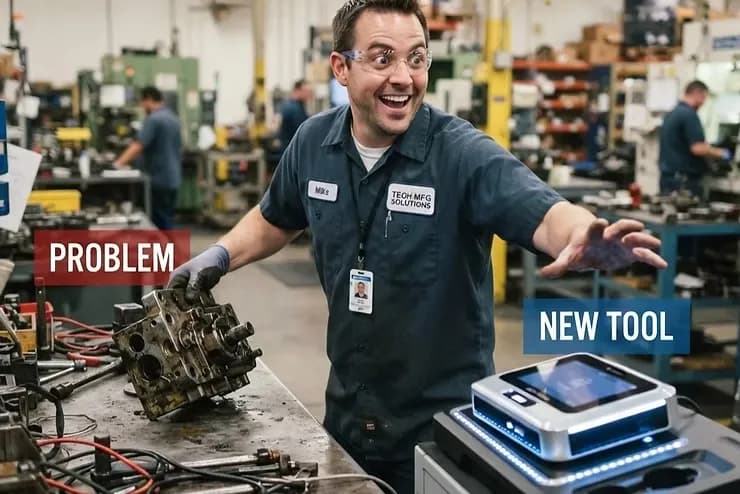
Continuous improvement tools are attractive because they are visible. You can see a board. You can see taped lines on the floor. You can see a supermarket, a shadow board, a kanban card, a dashboard, or a morning huddle. Those things are tangible - the problem they were designed to solve usually is not.
That is why plant tours can be both valuable and dangerous. We walk through a high-performing facility and naturally notice what is different from our own operation.
“They use this type of scheduling board.”
“They have point-of-use inventory.”
“They hold a daily meeting at 7:15.”
“They use these bins.”
“They have this software.”
Those observations are fine. The problem starts when observation becomes prescription. You go back to your shop and install the board, buy the bins, add the meeting, or configure the software without first understanding what gap we are actually trying to close.
Then, when it does not produce the same result, we conclude that the tool did not work.
The tool may have worked perfectly. It may simply have been solving the wrong problem.
A kanban system will not fix an unstable production schedule if the root issue is poor job readiness. A daily huddle will not improve performance if the team is only reporting status and there is no accountability to take action on recurring issues. New scheduling software will not make lead times predictable if nobody understands your actual capacity. Automation will not fix a process that changes every time a different person performs it.
Before choosing a tool, we need to understand the condition we are trying to change.
That sounds obvious. In practice, it is surprisingly easy to skip.
Caution: Sometimes your problem does not look like a problem anymore
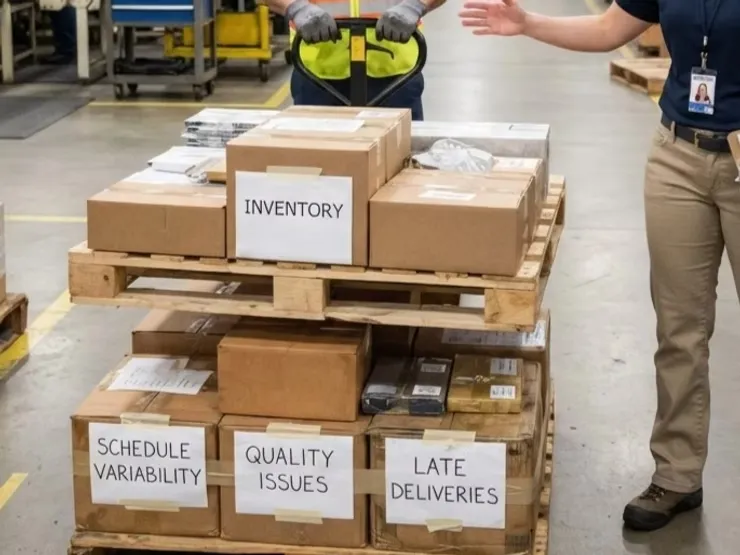
There is another challenge: sometimes leaders do not see the problem because the organization has already adapted to it. I recently visited a manufacturer where the operation was visibly cluttered and difficult to follow. There was inventory throughout the facility. The company increased batch sizes so they didn't run out or stock. Work moved in ways that were hard to see from the outside. What stood out to me was not just the condition of the shop. It was how normal the condition had become.
That is one of the harder parts of improving an operation. We are incredibly good at adapting.
When material regularly arrives late, start carrying extra inventory.
When the schedule is unreliable, build more product “just in case.”
When priorities constantly change, don't trust the schedule.
When information is missing, create your own spreadsheet.
When a process is inconsistent, put the best problem solver in the middle of it.
Each workaround solves an immediate problem, and each workaround can make the original problem harder to see. Now excess inventory hides the supplier problem. Large batches hide changeover issues. Expediting hides poor planning. Overtime hides capacity constraints. Tribal knowledge hides a broken process. An experienced employee quietly fixing everything hides the fact that the system cannot operate without them. Eventually, the workaround becomes the process.
That is when leaders can become “problem unaware.” It is not because they do not care or are unwilling to improve. The current condition has simply become the baseline.
“This is manufacturing.”
“We have always needed that much inventory.”
“Our customers change their minds all the time.”
“That is just how scheduling works here.”
“We need Bob because he knows how everything really works.”
Maybe.
Or maybe those are symptoms that have existed long enough that we no longer recognize them as symptoms. Before we can improve, we have to learn to see the difference between the work that creates value and the work that exists because another part of the system is unreliable.
Clarify the problem before trying to solve it
Once something feels wrong, the next temptation is to move quickly into solution mode.
That is understandable. Leaders are rewarded for solving problems. Continuous improvement professionals are trained in methods and tools. Owners have limited time and want action. When we have tools we saw on social media or a plant tour or heard at a conference, the solution is top-of-mind.
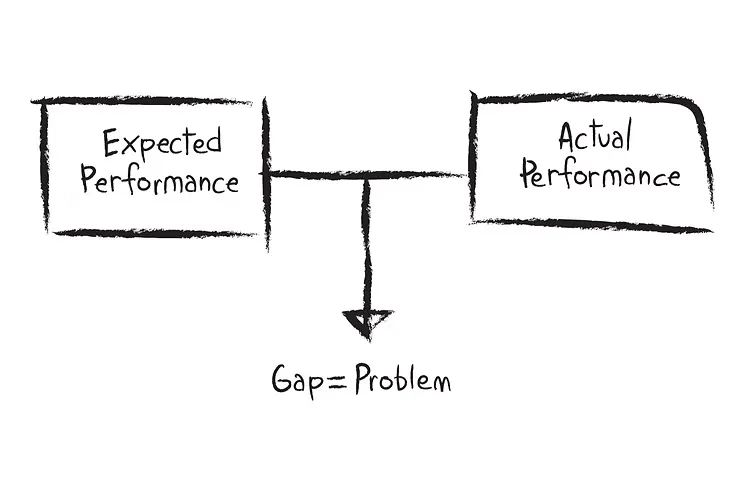
But speed at the wrong point in the problem-solving process can create more work later. The first job is to clarify the gap.
What should be happening?
What is actually happening?
How large is the difference?
How often does it occur?
Where in the process does the gap first become visible?
What conditions seem to exist when the problem occurs?
What is the business impact?
Those questions sound simple, but they force us to slow down long enough to understand the system.
For example, imagine a shop struggling with late deliveries. The immediate reaction might be to improve scheduling. But “late delivery” is an outcome, not necessarily the problem. Perhaps the team looks closer and finds that jobs are frequently released without all required material. Or perhaps programming is consistently completed after the scheduled start date. Or the machine has sufficient theoretical capacity, but setups and product mix reduce actual available capacity significantly. Or quoting is promising lead times based on machine time rather than the actual time a job spends moving through the business.
Now the problem looks different.
Each of those situations could produce the same symptom: late delivery. They would not require the same solution. That is why defining the problem is more important than selecting the tool. A useful starting point is to make the gap visible with a small number of facts.
Compare planned output to actual output.
Compare touch time to total lead time.
Compare scheduled start dates to actual start dates.
Track how often a job begins without everything required to finish it.
Measure how much work-in-process is waiting and why.
Look at how frequently priorities change after the schedule is released.
Ask employees where they spend time waiting, searching, expediting, or reworking.
The purpose is not to collect data forever. It is to create enough clarity that the team can say, “This is the condition we need to change.” Only then should we ask which countermeasure, method, or tool makes sense.
There is rarely a perfect time—and problems do not age well

Even when the problem becomes clear, another barrier often appears.
“It is just not a good time.”
I understand that response. There may be real financial constraints. Demand may be soft. Cash may be tight. The business may have a major customer launch underway. The leadership team may already feel stretched. Those are legitimate considerations. But there is an uncomfortable reality about improvement work:
There is rarely a perfect time to change the business.
When performance is poor, improvement can feel too expensive.
When performance is strong, improvement can feel unnecessary.
When everyone is busy, there is no time.
When the shop is slow, leaders may be reluctant to spend.
So when exactly is the right time?
That question becomes more important when we recognize that problems usually do not sit still while we wait - They age.
A recurring schedule problem creates more expediting.
Expediting creates new priorities.
New priorities create distrust in the schedule.
Distrust creates larger batches and more inventory.
More inventory hides flow problems and consumes cash.
Now the original scheduling problem has become several symptoms.
The organization adapts around the gap.
People create spreadsheets. They add meetings. They carry more safety stock. They schedule extra overtime. They hire another coordinator. They create another approval step. They give the best employee another responsibility.
Each response may make sense in the moment. But over time, those workarounds become embedded in the operating system. That is why problems do not age well. The longer a performance gap exists, the more likely the organization is to absorb its symptoms and build around them. Eventually, removing the original problem also requires unwinding all the behaviors created to survive it. That does not mean every issue requires a major initiative immediately. Improvement work still needs to compete for resources like everything else. But once we understand the problem and its impact, delaying action should be a conscious decision. We should know what it is costing us to wait.
Start by seeing more clearly
Continuous improvement does not begin with a tool. It begins with a better view of the current condition. See the gap before looking for a solution. Look for the workarounds that are hiding the real problem. Understand how the process actually performs, not how we assume it performs. Then decide what needs to change.
Sometimes the answer will be a familiar Lean tool. Sometimes it will be a process change, a clearer standard, a different metric, better planning, more visible information, or simply removing work that never needed to exist in the first place. The tool should follow the problem. Not the other way around.
If you are not sure what is really holding your operation back, that can be a useful place to start. A conversation or a focused site diagnosis can help make the current condition visible, identify the few problems creating the greatest drag, and turn those observations into a practical action plan.
You do not need to fix everything.
You need to see clearly enough to know what deserves attention next.
That’s how you #improveLESS … and get better results.