Nearshoring is an Opportunity … For Predictable Lead Times

The hidden math behind “cheaper parts”
Imagine you buy a component with:
- Average daily demand: 20 units/day
- Purchase price: $25/unit
- Safety stock: 10% (arbitrary, for illustration)
Scenario A: 8-week lead time
Lead-time inventory (basic approximation):
- 8 weeks × 5 days/week × 20 units/day
- = 8 × 5 × 20
- = 800 units
- Add ~10% safety stock: 800 × 1.10 = 880 units
- Inventory value at $25/unit: 880 × $25 = $22,000
So, the “cost” of an 8-week lead time isn’t just waiting longer.
It’s also $22,000 tied up in one component—cash you can’t use for:
- tooling/equipment
- staffing
- upgrades
- paying down debt
And that’s before you account for:
- expediting charges
- premium freight
- schedule churn
- late customer orders\
Nearshoring is showing up in more sourcing conversations—not as a buzzword, but as a practical shift toward regional suppliers who can respond faster, collaborate more closely, and reduce risk.
And nearshoring becomes a real advantage when your lead times are predictable.
If you’re a small fabricator, predictability isn’t a “nice-to-have.” It’s what lets you:
- quote with confidence
- schedule with less firefighting
- reduce inventory without increasing stockouts
- free up floor space and cash flow
Optimizing for unit cost can quietly subordinate system performance. A slightly cheaper part can become very expensive once it drives longer lead times, higher safety stock, more expediting, and more chaos.
Let’s make that concrete with simple math.
Scenario B: 2-week lead time (regional supplier)
Now take the same component and reduce lead time to 2 weeks.
- 2 weeks × 5 days/week × 20 units/day
- = 2 × 5 × 20
- = 200 units
- Add 10% safety stock: 200 × 1.10 = 220 units
- Inventory value at $25/unit: 220 × $25 = $5,500
That’s a reduction from $22,000 → $5,500.
Even if the regional supplier costs more per unit, the system math still wins.
Let’s say the unit price increases from $25 to $28:
- 220 × $28 = $6,160
So even with a higher unit price, your inventory cash drops from $22,000 → $6,160.
That’s $15,840 freed up on a single component.
Frequency matters too: from “big drops” to flow
Now layer in an additional lever: shipment frequency.
If you enter a supply agreement with:
- forecast updates through S&OP
- and twice-weekly shipments
…you move closer to flow and away from “big drop” inventory behavior.
A simple way to think about it is that if you reduce the amount you hold between deliveries, your average on-hand for that component can drop meaningfully—often by another ~50% depending on how you structure the replenishment and how stable the demand is.
Using your $6,160 number:
- $6,160 / 2 = $3,080
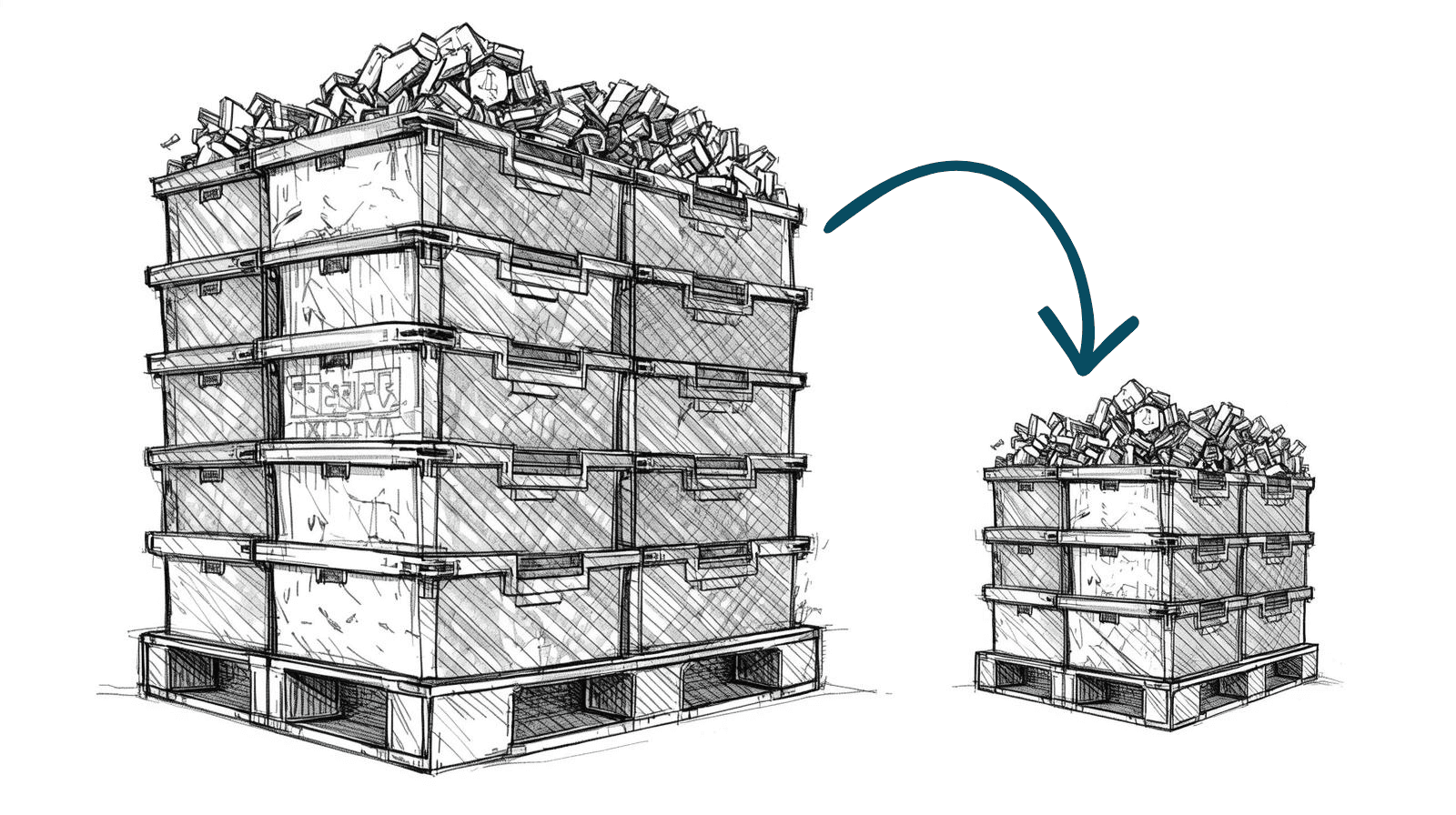
Now compare $22,000 (8-week lead time) vs. $6,160 (2-week lead time at higher unit cost ) or $3,080 (2-week lead time + more frequent shipments + shared planning cadence)
= 14% of the inventory value
Why predictable lead time changes forecasting (and stress)
Long lead times force you to forecast further out. And the further out you forecast, the higher chance for error. So shops respond by adding protection:
- bigger safety stock
- “just in case” inventory
- more WIP
- more expediting
It feels safe, but it creates a different kind of risk:
- cash flow risk
- obsolescence
- warehouse congestion (or 3PLs to hold your excess inventory)
- slower turns
- more searching, handling, and rework
Predictable lead time lets you update forecasts closer to the moment of use. That means:
- less variance
- fewer surprises
- smaller buffers
- and a calmer system
Nearshoring can enable that—but only if the relationship and process support it.
If your sourcing strategy is still dominated by “lowest unit price,” it’s easy to miss what you’re subordinating. You might be optimizing a part … and handicapping the enterprise system.
"Nearshoring" shifts the discussion from:
- “What is the unit cost?” to:
- “How does this supplier support our system performance?”
That’s a mature question.
What “mutually beneficial supplier development” looks like in practice
Supplier development is what makes nearshoring sustainable. Toyota is a well-known example of treating key suppliers as long-term partners—committing to capability building and cost reduction through process improvement, not just annual price-down demands. In North America, Toyota even established the Toyota Production System Support Center (TSSC) (originally the Toyota Supplier Support Center) to share TPS know-how and help organizations improve operations—because stronger suppliers create a stronger, more resilient supply chain.
This isn’t about being sentimental with suppliers. It’s about building a system that works.
A practical supply agreement for regional suppliers often includes:
- forecast updates through S&OP
- a short, frozen window
- standard flex ranges
- clear replenishment rhythm
- shared problem-solving when variability spikes
A reflection question for your sourcing decisions
Before you select a supplier based on unit cost, ask:
“What will this decision do to our lead time, our inventory, and our ability to make reliable promises?”
Because the shops that win with nearshoring won’t be the ones who found a nearby supplier.
They’ll be the ones who built predictable lead times and structured the relationship so both sides can plan, ship, and improve together.
That’s how you #improveLESS … and get better results.