
Stop Stacking Initiatives: Install Stability Before the Next Change
Updated: Dec 17, 2025
A few weeks ago, a client surprised me in a way that (honestly) made me smile.
They hit pause.

Not because the business was slow. Not because they ran out of ideas. But because they finally recognized what was really happening:
They were stacking strategic initiatives on top of an operation that hadn’t stabilized from the last round of change.
So, the leadership team made a call:
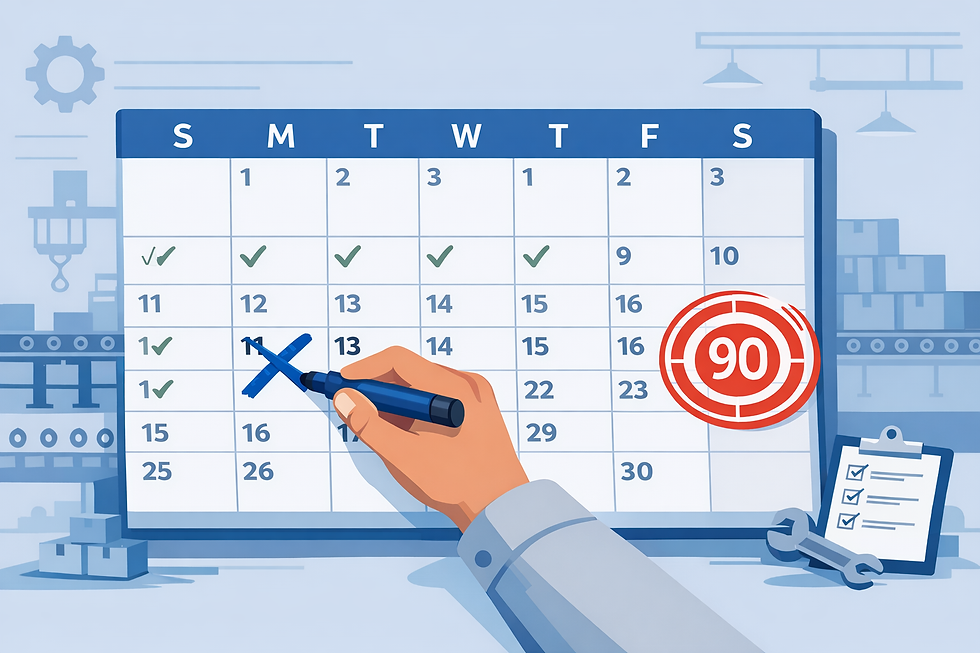
“For the next 90 days, we’re not launching anything new. We’re going to stabilize, solve problems, and build a system that can hold the gains.”
That decision is rare. And it’s exactly how mature organizations get faster.
Why stacking initiatives makes you slower
Most leaders don’t intend to create chaos. They’re trying to improve. They’re trying to respond. They’re trying to keep up.
But here’s the pattern I see (over and over):
An initiative gets launched (new system, new KPI, new process, new “program”).
Early momentum looks promising.
Variation shows up (quality dips, schedules miss, overtime climbs, people improvise).
Leaders jump in to “push it through.”
Before the operation stabilizes, the next initiative starts.
Now you’re not improving. You’re accumulating disruption.
And disruption has a cost:
firefighting replaces learning
workarounds replace standards
“busy” replaces progress
There’s also a human cost. Research on repetitive reorganizations shows that uncertainty and workload are major drivers of change fatigue—which then increases resistance to future change. (Taylor & Francis Online)
If you want sustainable performance, you can’t treat people like they have unlimited capacity to absorb disruption.
The fastest organizations stabilize fast
There’s a paradox here that’s easy to miss:
The organizations that change the fastest are the ones with the strongest stability backbone.
One well-known framing (from the agility world) is that truly agile organizations learn to be both stable and dynamic—with a relatively unchanging “backbone” that enables speed. (McKinsey & Company). This matches what I see in manufacturing and operations:
When your system is stable, you can:
see problems quickly
separate noise from signal
test changes without breaking everything
sustain gains without heroics
And from an Improve LESS mindset, this is the point: don’t confuse “launching projects” with building capability. Focus creates flow—and flow requires stability.

The best way to stabilize: level load and standardize
When leaders say, “We need stability,” they often jump straight to documentation.
But if your demand, staffing, quality, materials, or equipment reliability are unstable, a written procedure turns into shelfware. I wrote about this earlier: stabilize first, standardize second—otherwise you’re codifying chaos. (Bareither Group Co 1)
So how do you stabilize fast without overcomplicating it?
1) Level load (smooth the system)
Level loading (heijunka) is one of the most practical stability levers you have. Done well, it reduces the unevenness that creates firefighting and overburden. It’s specifically used to create predictability and stability by smoothing volume and mix over time.
In plain language: stop whipsawing your operation. Even if you can’t perfectly level customer demand, you can:
level what you release to the floor
define a realistic, known capacity
set production to a steady rhythm as much as possible
protect bottlenecks from schedule chaos
When the plan stops changing every hour, problem-solving gets easier. Performance becomes less variable. People can breathe—and think.
2) Standardize (create the baseline that exposes problems)
Standardized work reduces variability and gives you a baseline for improvement. It supports training, consistency, and makes abnormalities visible. (Lean Enterprise Institute)
But here’s the nuance that matters, you don’t need a 40-page SOP to stabilize. Start by standardizing what creates stability first:
the “best-known way” for the critical steps
visual cues at the point of use
leader standard work / daily confirmation
a simple escalation path when the process misses
Daily management matters here because it brings actionable information to leaders on a predictable basis. This is how stability becomes a system—not a slogan.
A simple 90-day plan to practice “installing stability”
If you’re going to pause new initiatives, like my client did, you need a plan that feels actionable. Here’s a pattern that works:
Days 1–30: Stabilize the rhythm
Define “known capacity” and the constraint
Level the release plan (even if imperfectly)
Write down your daily plan vs. actual review
Track top disruptions - quality, equipment downtime, staffing, material issues
Days 31–60: Standardize the current best way
Create standard work for the constraint and key handoffs
Train, verify, and visually support the standard
Add basic controls (error-proofing, PM, simple checks)
Tighten response: when it’s off-standard, we swarm it
Days 61–90: Solve root causes and lock in sustainment
Convert repeat disruptions into problem-solving
Reduce the “special causes” that steal capacity
Confirm leaders are protecting the cadence (calendar wins or chaos wins)
At the end of 90 days, you should be able to say:
performance is more predictable
problems surface faster
improvements stick longer
the organization has more capacity for the next change
Before you start the next initiative, ask:
Is the operation level-loaded so we can see reality?
Do we have a clear “current best way” for the critical work?
Do leaders get information daily—so issues don’t hide for weeks?
When we miss, do we problem-solve… or do we “push harder”?
If you can’t answer “yes” to most of these, the next initiative isn’t your bottleneck.
Stability is.
Focusing on Stability not just the next change is how you #improveLESS ... and gey better results.


Comments