The Missing Link Between Strategy and the Shop Floor

“We have a strategy.” - “We have a morning meeting.” - “But they don’t seem connected.”
That is where many small shops get stuck.
Leadership sets a priority. The team reviews yesterday’s issues. Customers keep calling. Expedites keep happening. The same problems show up again next week.
The issue is not effort.
The issue is that the strategy never became a process change. And that is the missing link.
Process improvement is the bridge between strategy deployment and daily management.
- Strategy deployment defines the gap.
- Process improvement changes the work.
- Daily management checks whether the new way is working.
Without process improvement, strategy stays too abstract.
Without daily management, improvements do not hold.
Strategy deployment defines the gap
Strategy deployment should narrow the focus.
X Not twenty priorities.
X Not every problem in the business.
X Not a long list of improvement ideas that all sound important.
A focused strategy answers a few simple questions:
What matters most right now?
What result needs to change?
What few initiatives will help close that gap?
What will we intentionally not chase this quarter?
For a small fabricator, the strategic objective might be:
Improve delivery reliability.
That is a strong objective.
It matters to customers. It impacts cash flow. It affects trust. It influences repeat work. It creates pressure across the whole business.
But by itself, “improve delivery reliability” is still too broad for daily action.
The team cannot walk into the morning meeting and simply say, “Let’s improve delivery reliability today.” They need to know where delivery reliability is being won or lost.
That is where process improvement enters.
Process improvement is the bridge
Strategy says:
“We need better delivery reliability.”
Process improvement asks:
“Which process is creating the delivery gap?”
That question changes the conversation.
- Maybe the issue is not the welding cell.
- Maybe jobs are being released before material is available.
- Maybe drawings are incomplete.
- Maybe purchasing is reacting too late.
- Maybe the schedule changes too often.
- Maybe inspection is finding problems after too much work has already been completed.
- Maybe quoting promised a date the current system could not support.
- Maybe no one has clearly defined what “ready to run” actually means.
This is where strategy becomes real. Not in the annual planning document. Not in the leadership offsite. Not in a slide deck. Strategy becomes real when the team identifies the process behavior that must change.
For example:
Strategic Objective: Improve delivery reliability
Goal: Increase on-time delivery from 78% to 92%
Process Gap: Jobs are being released to production before programming is complete
Process Metric: Percent of jobs ready before scheduled start (%)
Improvement Work: Define job-ready criteria, create a release checklist, clarify ownership
Daily Management Question: Are tomorrow’s jobs ready to run?
That is the bridge.
Not more strategy. Not more reporting. A clearer process.
The morning meeting is not a status update
This is where many organizations miss the opportunity. They have a morning meeting. People gather around a board. They talk about what happened yesterday. They review what is late. They mention the hot jobs. They discuss who is out, what material is missing, and which customer called.
That information may be useful. But awareness alone does not create transformation.
A status update sounds like this:
“Job 123 is late.”
“We are waiting on material.”
“[Customer] called again.”
“We are short-handed today. Owen is out.”
All of that may be true. But if the meeting stops there, the business has only created shared awareness of the same problems. Daily management should do more than share status. It should create learning and drive action.
A better daily management conversation asks:
- What was supposed to happen?
- What actually happened?
- What process gap caused the miss?
- What action are we taking today?
- What needs to be escalated?
- What did we learn that we should change in the system?
That is a different kind of meeting. It is not a place to admire problems.
It is not a place to assign blame. It is not a place for leaders to collect updates from everyone else. It is the daily check on whether the process is supporting the strategy.
Why this matters for small fabricators
Small shops often have plenty of activity.
They have customer demand. They have urgent jobs. They have quotes to complete. They have material to chase. They have employees working hard. They have equipment that needs to stay running. But activity is not the same as alignment.
A shop may have:
A growth goal.
A delivery problem.
A morning meeting.
A production schedule.
A few improvement ideas.
A team that genuinely cares.
But those pieces may not be connected. So, the business keeps reacting. The strategy lives in leadership conversations. The morning meeting lives in daily firefighting. The process problems live in tribal knowledge. That separation creates drag.
Everyone is busy, but the system does not get much better. When the pieces connect, the business starts to operate differently. Leadership focuses the strategy. The team improves the process that matters most. The morning meeting checks whether the process is stable.
Problems become visible sooner. Actions become clearer. Learning becomes more frequent. And transformation becomes practical.
Not theoretical.
Not complicated.
Not dependent on a massive program.
Just a tighter connection between what matters, how work gets done, and what the team talks about every day.
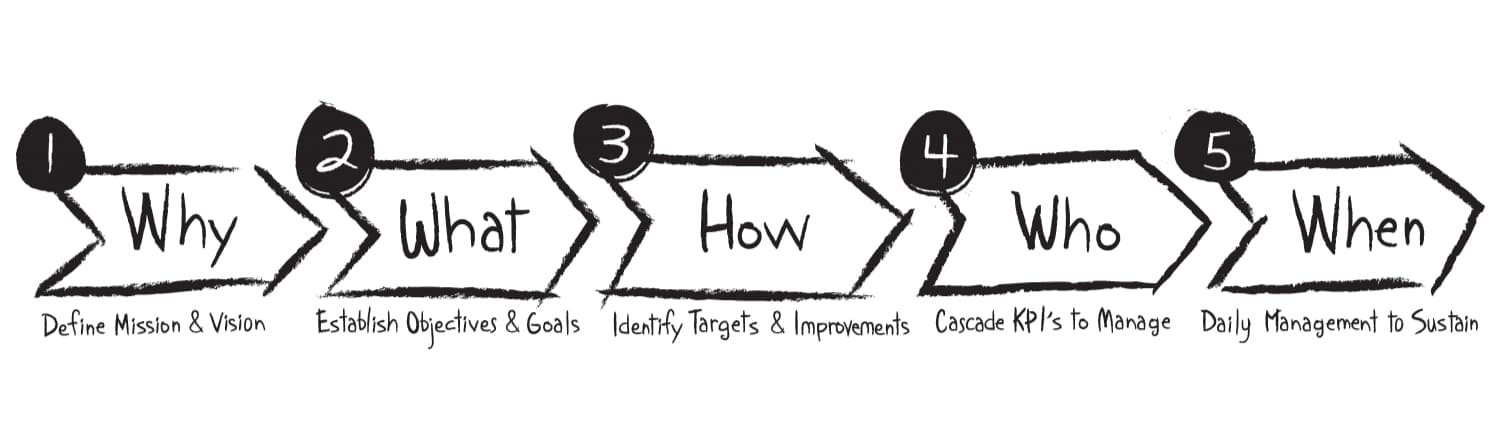
A simple framework: \
the strategy-to-daily-management bridge
Here is a simple way to connect strategy deployment, process improvement, and daily management.
1. Focus the strategy (Why)
As you think about your plans for the organization, choose one or two objectives that matter most for your vision. I like 90-day time horizons. What is something that we need to fix now and 'why' does it matter to us and our customers.
For a small fabricator, that might be delivery reliability, quote speed, margin improvement, capacity visibility.
The key is focus.
If everything is a priority, nothing is a priority.
2. Define a goal for your objective (What)
If the objective is delivery reliability, the process gap may be on-time delivery, schedule adherence, job backlog.
The goal is to move from a broad statement to a specific measure.
3. Translate into a process gap (How)
Collectively decide where is this result being created or lost?
If the objective is delivery reliability, the process gap may be job readiness, schedule adherence, material availability, engineering changes, quality escapes, or shipping accuracy. The goal is to move from a broad result to a specific process.
How do we currently delivery that requirement. Then, clarify the process/standard/tool that is leading to the gap
Is ownership of the work clear?
What information is needed vs. available?
Where does work wait for something?
Where do we repeat mistakes?
This is where improvement becomes practical.
4. Choose a process metric and owner (Who)
Do not only measure the final result (revenue, cost, on-time delivery) after it is too late.
Choose a process metric the team can influence in daily work before the customer feels the miss.
For delivery reliability, that may be:
- Percent of jobs ready before scheduled start.
- Percent of jobs started on time.
- Material availability for the next 48 hours.
- Schedule adherence.
- First-pass yield.
- Rework hours.
The right process metric gives the team an earlier signal. And, identify someone who will capture this metric for the team to review. This is an important distinction - they are the metric owner, not the person to blame.
5. Review it in the morning meeting (When)
Bring the process metric into the daily conversation. Not as a scoreboard to judge people. As a signal to learn from.
Ask:
- What was the plan?
- What happened?
- What gap do we need to address today?
- Who is taking action?
- What needs to be escalated?
- What should we change in the process if this keeps repeating?
When the same issue shows up again and again, do not just fix today’s schedule. Fix the process. That may mean changing a handoff, clarifying ownership, improving visibility, adjusting the planning cadence, updating the job release criteria, or removing a recurring source of confusion. The goal is not just to survive the day. The goal is to make tomorrow more predictable.
A brief example
Imagine a small fabrication shop with this strategic objective:
Grow revenue with existing customers.
That sounds like a sales objective. But one of the biggest obstacles may be operational. Customers are hesitant to award more work because delivery performance is inconsistent.
To get more specific we quantify the objective with a goal.
Increase number (#) of jobs with top customers.
This helps us get more focused so the team can be aligned on what needs to change to achieve that strategy.
If our on-time delivery is not where we want and have that feedback from customers, perhaps we focus on:
Improve delivery reliability to earn more repeat work.
Now the team looks for the process gap. They discover that many jobs are being started without all materials, drawings, fixtures, or priorities clearly defined. The process metric becomes: Job readiness for the next 48 hours.
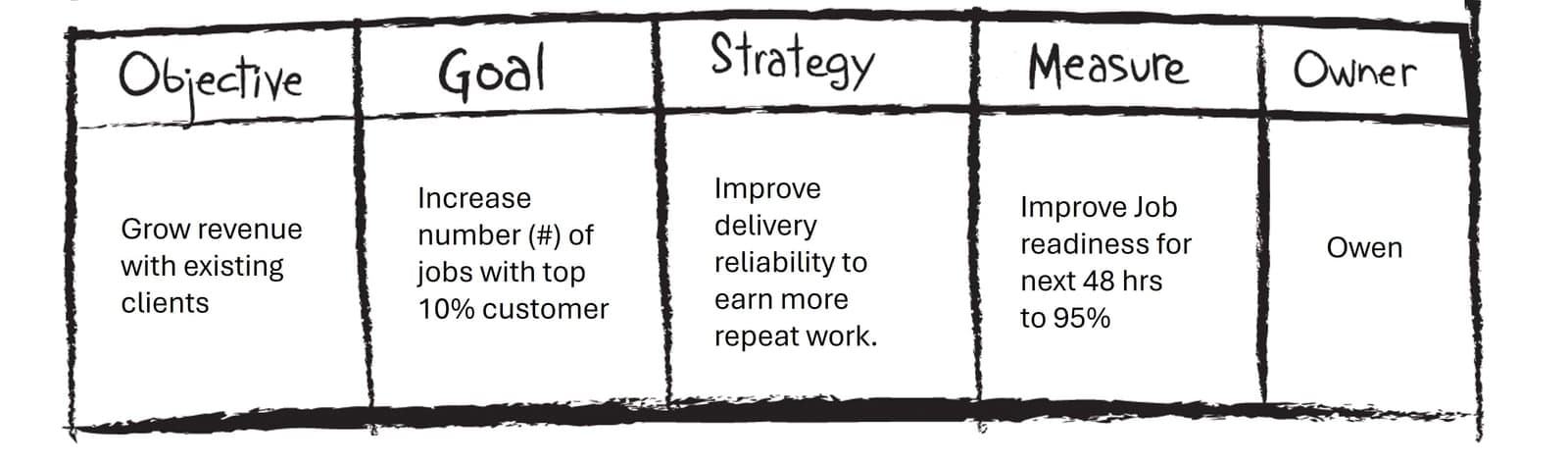
The morning meeting question becomes:
What jobs are not ready, why, and who is removing the obstacle today?
That one question changes the meeting.
The team is no longer only asking:
“What jobs are late?”
They are asking:
“What is preventing job prep (materials/programming/secondary ops) before it becomes late?”
That is the difference between status reporting and daily management. And it is the difference between having a strategy and actually deploying one.
Strategy deployment defines the few things that matter.
Process improvement changes how the work gets done.
Daily management checks, learns, acts, and sustains.
That is the missing link between strategy and the shop floor.
That’s how you #improveLESS … and get better results.
#lean #sixsigma #processimprovement #continuousimprovement #operationalexcellence